REVIEW · LISBON
Lisbon: City Sightseeing Hop-On Hop-Off Bus Tour
Book on GetYourGuide →Operated by City Sightseeing Europe · Bookable on GetYourGuide
Lisbon clicks into place fast. This tour shines because you get three hop-on hop-off routes with audio in 13 languages, so you can steer your own day from Belém to the viewpoints above the river. I also like the 48-hour option, which layers in a night panoramic ride and two walking tours, turning the bus ticket into more than just sightseeing-from-a-seat. One possible drawback: the open-top top deck is not built for bad weather, and it can be a bit of work to spot the exact stops when you’re new to Lisbon.
You start at Marques de Pombal Square, and from there the buses fan out across different neighborhoods—so you’re not stuck doing just one side of the city. The routes cover major landmarks like Jerónimos Monastery and Torre de Belém, plus squares you’ll want to stroll through, like Praça do Comércio and Praça do Rossio.
At about $37 per person for the ticket (with 24- or 48-hour validity depending on what you choose), it’s a good value if you want convenience and lots of flexible stops. It’s less ideal if you only care about one area, because entry fees to attractions and food are not included.
In This Review
- Key things to know before you ride
- Where the tour fits in Lisbon: start at Marques de Pombal
- The Red Route: Belém UNESCO sights plus classic Lisbon riverfront
- The Blue Route: museums and the Oceanário area for full-day variety
- The Green Route: Alfama-side hills, castle area, and markets
- Squares, gardens, and cathedral stops you can actually use
- The 48-hour ticket: night panorama and two timed walking tours
- How often buses run and how to time your hops
- Audio quality, stop-finding, and weather reality on the top deck
- Price and value: is $37 a smart move?
- Who should book this hop-on hop-off bus tour?
- Should you book it?
- FAQ
- How long is the hop-on hop-off ticket valid?
- Where does the tour start?
- Which UNESCO World Heritage Sites are on the routes?
- What’s included with the 48-hour ticket?
- What time do the buses run on each route?
- What languages are available for the audio guide?
- Is the tour wheelchair accessible, and are pets allowed?
Key things to know before you ride
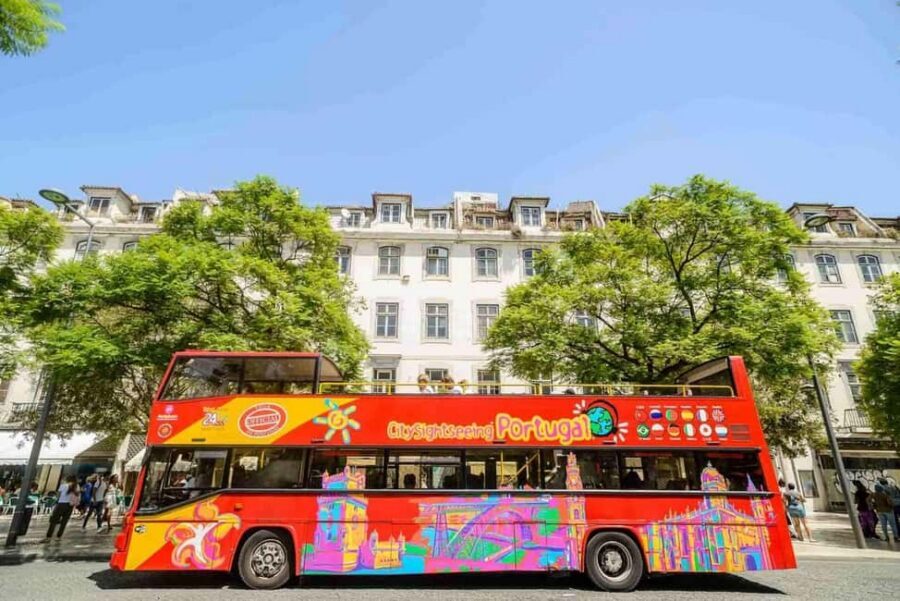
- Three routes, 40+ stops: Red, Blue, and Green loop through the sights with hop-on hop-off freedom.
- UNESCO highlights on the Red Route: Jerónimos Monastery and Torre de Belém are part of the main circuit.
- Audio headphones in 13 languages: English plus many others, so you can tune out the walking and focus on what you see.
- 48-hour upgrade adds real extras: A night tour plus two walking tours (time-specific departures).
- Open-top comfort is weather-dependent: In rain and wind, top-deck comfort can drop fast.
- Some stops can be tricky to locate: Signage uses location names, and you may need to scan around the stop area.
Where the tour fits in Lisbon: start at Marques de Pombal

Marques de Pombal Square is the main launch point, and that’s handy. It sits in a central zone, so you can make the bus your moving base while you decide what to see next. If you’re the type who likes to plan lightly—then adjust as you go—this format is built for that.
The ticket gives you access to three routes. Even if you don’t ride all of them end to end, the network effect matters: you can hop off near a museum, return to the stop later, and switch to another line for a different neighborhood without paying for new transport each time.
You’re also listening with headphones, not relying on a live guide shouting over the city. That means you control the pace—pause your attention for photos when you want, then restart when you’re ready for the next explanation.
You can also read our reviews of more city tours in Lisbon



The Red Route: Belém UNESCO sights plus classic Lisbon riverfront

If you want the most famous Lisbon scenery in one go, the Red Route is your backbone. It runs from 9:30am to 5:00pm, with departures every 30 minutes. Each route run takes about 105 minutes, and it’s the one that connects the central city with the big river landmarks.
Along the way, you pass through some of Lisbon’s favorite “walk a little and look around” zones. Stops like Parque Eduardo VII are a common entry point to wide city views. Príncipe Real and Bairro Alto are your cues for neighborhoods known for lively streets and pleasant wandering.
The Red Route also includes the practical stuff that makes sightseeing easier. Cais do Sodré is a major hub area, and you’ll also see Museu dos Coches, which is the kind of stop that rewards a short visit if you like Portuguese culture and historic vehicles.
Then comes the Belém cluster, and this is where the bus earns its keep:
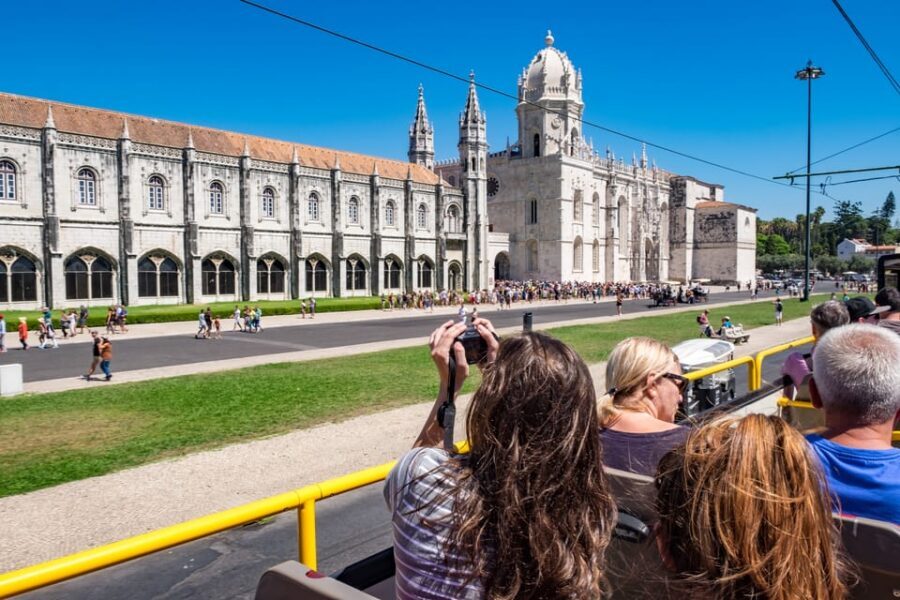
- Mosteiro dos Jerónimos: a UNESCO World Heritage site tied to Portugal’s Age of Discoveries.
- Torre de Belém: the iconic tower view you’ve probably already seen in photos.
- Padrão dos Descobrimentos: a strong “context stop” near the river story.
- MAAT (Estação Fluvial – MAAT) and the Docas area: useful if you want modern museums and riverside scenes rather than only historic monuments.
- Basilica da Estrela: a major landmark for cathedral-style architecture and a change of pace after the waterfront.
One drawback to keep in mind: even with hop-on hop-off convenience, this route can turn into an all-day Belém plan if you hop off and linger at more than one stop. If you have limited time, pick your top two or three stops and let the rest be your next trip.
The Blue Route: museums and the Oceanário area for full-day variety

The Blue Route is the one I’d choose when you want a mix of culture and modern Lisbon. It runs from 10:00am to 5:00pm, departing about every 40 minutes, with the same roughly 105-minute loop time per full ride.
This line starts in the same central area (Marques de Pombal) and then spreads toward museums and big-sight districts. You pass by areas like Campo Pequeno and reach Santa Apolónia, which is a useful stop if you’re trying to thread together river-adjacent sights with inland attractions.
A big reason the Blue Route is worth your attention is the museum grouping:
- Museu da Água
- Museu do Azulejo
These are exactly the kind of places that work well when you can hop off early, spend a focused block of time inside, then rejoin the bus later.
For aquarium lovers, this route has a strong anchor: Oceanário de Lisboa. If you plan to visit the aquarium, timing matters because it can eat a chunk of time that feels longer than you expect—especially if you’re taking your time with exhibits.
The Blue Route also reaches Torre Vasco da Gama and the Gare do Oriente area, plus stops that support a wider day like Jardim Zoológico. If you’re traveling with someone who wants both views and structured stops, this line tends to balance the day better than “only monuments.”
The Green Route: Alfama-side hills, castle area, and markets
The Green Route is for Lisbon’s dramatic topography. It runs from 10:00am to 5:00pm, with departures about every 30 minutes, and it loops in about 105 minutes per full circuit.
This route is where you’ll see classic Lisbon hill neighborhoods and viewpoints. It includes stops near Rua S. Bento (Parlamento) and comes down into areas like Martim Moniz, a neighborhood you’ll notice immediately if you’re crossing between the formal central grid and older streets climbing into the hills.
The headline stop is Castelo de São Jorge (listed as Castelo S. Jorge). If you’re going up, use the bus to get you close, then let walking do the final work. You’ll also reach:
- Miradouro da Graça: viewpoint territory.
- Panteão Nacional: another key Lisbon landmark zone.
- Feira da Ladra: market area vibes, especially useful if you’re visiting when markets are active.
- Rua Palma – Praca da Figueira and Restauradores areas: these are helpful for connecting to city-center strolling and squares.
A practical tip: the Green Route is a strong choice when you know you’ll do stairs and short walks. If you prefer flatter strolls, you might use this line only for the castle/viewpoint segment, then switch back to Red or Blue for easier recovery.
Squares, gardens, and cathedral stops you can actually use
Lisbon is a city of short walks that turn into longer walks. This tour respects that reality because you’re not forced into a single fixed itinerary.
You’ll be able to hop near major squares like Praça do Comércio, Praça do Município, and Praça do Rossio. Those names matter because they’re anchors—good places to re-orient yourself, grab a snack from somewhere nearby, and then move on when you feel ready.
For gardens, the route network helps you reach two of the more pleasant “pause your day” spots referenced in the tour description:
- Jardim da Astrela
- Jardim do Príncipe Real
Because these gardens sit in different parts of town, the value here is that you can build in a “sit and reset” break without reorganizing your whole day around it.
For cathedral-style architecture, Basilica da Estrela is the clearly named stop. It’s the kind of landmark that benefits from hopping off, taking in the exterior, and then deciding whether you want more time inside.






The 48-hour ticket: night panorama and two timed walking tours
If you choose the 48-hour option, you’re adding Lisbon-on-foot and Lisbon-at-night, not just more bus time. The night component is a panoramic bus tour that starts at 8:00pm from Marques de Pombal and runs about an hour.
That’s a smart add-on because Lisbon looks different after dark. You’ll get the same strategic convenience of the hop-on hop-off format, but with lighting and evening mood doing some of the storytelling.
You also get two walking tours with specific daily departures:
- Carmo – Miradouro São Pedro de Alcantara Walking Tour: meets at Rua do Carmo and departs at 10:00am, lasting about 1 hour.
- Castle – Alfama Walking Tour: meets at Stop 4 on the Green Route and departs at 5:00pm, lasting about 1 hour.
These walking tours are the part that turn this from a bus service into an actual “see it like a city” experience. The trick is planning your hop-on hops so you’re not fighting the clock.
If you want a day that flows, I’d treat the walking tours as your fixed points. Everything else—museum hops, river time, shopping breaks—should be flexible around those times.
How often buses run and how to time your hops
Buses aren’t constant all day. Knowing the schedule will help you avoid that “wait 20 minutes?” feeling.
Here’s the core rhythm:
- Red Route: first departure 9:30am, last 5:00pm, about every 30 minutes
- Blue Route: first departure 10:00am, last 5:00pm, about every 40 minutes
- Green Route: first departure 10:00am, last 5:00pm, about every 30 minutes
Each route run is about 105 minutes, so don’t treat it like a quick shortcut. It’s more like a rotating sightseeing corridor. If you hop on, then immediately hop off at the next stop, you won’t get the full value—but if you’re using it to move between neighborhoods while you explore, it makes sense.
One practical heads-up: on Saturday, 10 May, the last departures from Stop 1 change due to a football event. The last times are listed as:
- Red line: 1:30pm
- Blue line: 1:20pm
- Green line: 1:25pm
If you’re there around that date, plan your final bus ride earlier than you think.
Audio quality, stop-finding, and weather reality on the top deck
Headphones help, because you’re not straining to hear over traffic. Still, the tour is audio-based, and it can feel like the bus is more about movement than deep narration. If you care about details, I’d do it this way: listen for the essentials while you pass, then hop off for the part you actually want to study.
Stop-finding is another real-world factor. The system uses location names, not always an easy stop-number routine. That can make the first day a little slower, especially when the sign is visible from only certain angles. The fix is simple: arrive at a stop early, look for the branded stop area, then get ready before the bus shows up.
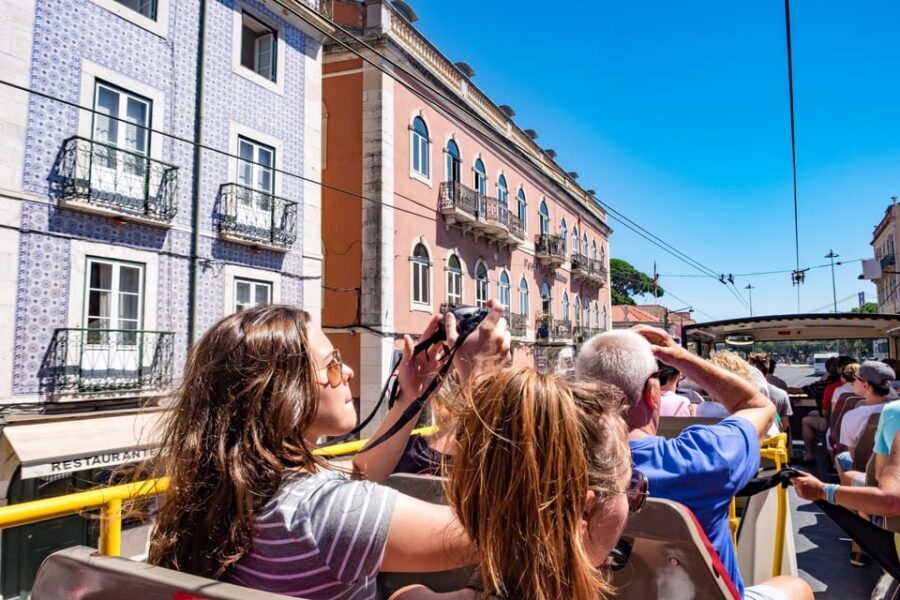
Weather is the other big factor. Since it’s an open-top double-decker experience, a sunny day feels great. But if you hit heavy rain, expect the top deck to be less comfortable. Bring a light rain layer or keep your main riding time planned for when the weather is kinder.
And yes, sun matters too. On clear Lisbon days, the top deck can warm up quickly, so sunscreen is smart.
Price and value: is $37 a smart move?
For about $37 per person, you’re buying flexibility plus a lot of built-in logistics. What makes it feel like value isn’t the bus itself—it’s the way it helps you chain neighborhoods together without overthinking.
This tour is best value when:
- You want to see many parts of Lisbon in limited time.
- You’re okay mixing short stops with longer wandering.
- You plan to pick a few “real time” attractions to pay for separately, while using the bus to position you near them.
It is not the best choice if you’re happy doing everything by foot in one compact area. Because the included part is transport and audio, your money goes further when your wishlist spans different districts—Belém, central squares, hill viewpoints, and museum zones.
Also note what’s not included: entry to attractions and food and drinks. That’s normal for this kind of tour. Just be ready to budget separately once you decide where you want to spend your money on tickets.
Who should book this hop-on hop-off bus tour?
This is a great match if you:
- Want a low-stress way to get bearings fast.
- Like structure-free exploring, with the option to bail and switch routes.
- Prefer comfort while moving, then enjoy walking in short bursts.
It’s also a good pick for families and mixed-age groups, because you can pace the day. One person can browse longer at a stop while another rests, then you reunite at the next hop-on point.
You might skip or downsize the plan if you:
- Are only interested in one area and don’t want to move around much.
- Hate waiting for scheduled departures.
- Know you’ll be miserable in rain on the open top deck and don’t plan around it.
Should you book it?
I’d book this if you want to see Lisbon efficiently while staying in control. The mix of three routes, audio in 13 languages, and major anchors like Jerónimos Monastery and Torre de Belém makes it a strong first-pass option—especially if it’s your first day in town.
If you can swing the extra time, I’d lean toward the 48-hour ticket for the night panorama and the two walking tours. That’s where the experience feels more like a city day than just transportation.
FAQ
How long is the hop-on hop-off ticket valid?
The ticket is valid for 24 or 48 hours, depending on the option you select. The activity also notes validity as 1–2 days, based on available starting times.
Where does the tour start?
The tour starting point is Marques do Pombal Square.
Which UNESCO World Heritage Sites are on the routes?
Jerónimos Monastery and Torre de Belém are both included as sights you can access via the bus routes.
What’s included with the 48-hour ticket?
A night-time panoramic bus tour is included, along with two walking tours: Carmo – Miradouro São Pedro de Alcantara (10:00am from Rua do Carmo) and Castle – Alfama (5:00pm, meeting at Stop 4 on the Green Route). A boat tour may also be available if you select the appropriate option.
What time do the buses run on each route?
Red Route runs from 9:30am to 5:00pm (every 30 minutes). Blue Route runs from 10:00am to 5:00pm (every 40 minutes). Green Route runs from 10:00am to 5:00pm (every 30 minutes).
What languages are available for the audio guide?
The audio guide is available in English, Spanish, French, German, Italian, Dutch, Japanese, Chinese, Portuguese, Russian, Polish, and Ukrainian (plus one additional language listed in the set).
Is the tour wheelchair accessible, and are pets allowed?
Wheelchair access is listed as available. Pets are not allowed, and smoking is not permitted.