REVIEW · LISBON
Tuk Tuk Lisbon: Lisbon Iconic Highlights 1.5-Hour
Book on GetYourGuide →Operated by TukGuide Portugal · Bookable on GetYourGuide
Lisbon from a tuk-tuk feels like a cheat code. You get major sights in only 90 minutes, without racing between stops on foot. This is a 100% electric ride with a guide who helps you connect the dots across neighborhoods and viewpoints.
I especially love the way the route strings together big landmarks (Rossio, Commerce Square, Lisbon Cathedral) with high-payoff viewpoints (Graça and Senhora do Monte). I also like the practical setup: the vehicle has transparent, waterproof covers so the ride stays comfortable when weather turns.
One thing to consider: this tuk-tuk is not wheelchair/walker accessible, and it also isn’t suitable for children under 7 or for pregnant women.
In This Review
- Key Things That Make This Tour Worth Your Time
- 1.5 Hours on an Electric Tuk-Tuk: Fast, Scenic, Low-Stress Lisbon
- Where You Start and How the Route Feels: Restauradores to Rossio
- Avenida da Liberdade to Rossio: The Big-Sightseeing Layer
- Baixa and Rua Augusta Arch: Getting Your Bearings Fast
- Lisbon Cathedral (Sé): A Stop That Grounds the City in Centuries
- Portas do Sol and Miradouro de Santa Luzia: Two Photo Stops, Worth the Views
- Convento da Graça, Graça, and Street Art: Lisbon’s Creativity on Display
- Miradouro da Senhora do Monte: The Longer View Stop
- São Vicente de Fora Monastery: Cloisters and Panoramic Outlook
- Campo de Santa Clara and National Pantheon: Big Monuments on a Tight Schedule
- Fado Museum and Alfama: Culture Stops That Make Sense Here
- Commerce Square (Praça do Comércio) and Tagus Views: Lisbon’s Waterfront Moment
- Rua da Madalena and Mouraria: The Streets Between the Icons
- Elevador de Santa Justa: A Quick Glimpse That Still Counts
- What’s Included (and Why It Matters)
- The Guide Experience: Friendly, Clear, and Focused on Lisbon’s Story
- Who This Tour Suits Best
- Price and Value: Is $56 per Person Fair?
- Should You Book Tuk Tuk Lisbon Highlights 1.5-Hour?
- FAQ
- How long is the Tuk Tuk Lisbon Iconic Highlights tour?
- What does the tour cost?
- Where is the tour located?
- Do I get hotel pickup and drop-off?
- Is this tour private?
- What languages are available for the live guide?
- What’s included in the price?
- Is monument entry included?
- Is the tuk-tuk wheelchair or walker accessible?
- What should I bring?
Key Things That Make This Tour Worth Your Time

- Electric tuk-tuk comfort with transparent and waterproof covers that keep views going in rainy conditions
- A speaker so your guide stays clear, even when streets get noisy
- Story-led route that links Restauradores, Baixa, Alfama, and multiple miradouros instead of doing random stops
- Two focused photo breaks at Portas do Sol and Miradouro de Santa Luzia (about 5 minutes each) plus a longer one at Senhora do Monte (about 10 minutes)
- Ginjinha included, so you get a true Lisbon taste without hunting for it after the tour
- A guide who explains clearly, including examples like Filipe being praised for friendly, helpful historical context
1.5 Hours on an Electric Tuk-Tuk: Fast, Scenic, Low-Stress Lisbon

If you want Lisbon’s highlights without burning half a day on staircases, this 1.5-hour electric tuk-tuk format makes a lot of sense. The tour covers a tight loop that moves you through several of the city’s most recognizable areas. You won’t get stuck figuring out routes or timing buses. Instead, you’re carried between key points while a storyteller keeps the context going.
And it’s not just “ride around and see stuff.” The vehicle is set up for real sightseeing: there are transparent, waterproof covers so you can still look out even if the sky threatens rain. On cold days, you also get blankets. That combination matters because Lisbon weather can shift quickly, and you don’t want sightseeing to turn into a shiver contest.
Because it’s a private group, you’ll have a more natural conversation with the guide. Also, the tuk-tuk can handle up to 6 people (and up to 400kg), so it’s built for small groups rather than large crowds.
You can also read our reviews of more tours and experiences in Lisbon.



Where You Start and How the Route Feels: Restauradores to Rossio

The tour begins at Restauradores Square, a lively spot at the north end of Avenida da Liberdade. You start by seeing the monument tied to the restoration of Portugal’s independence. Even if you’re not a monument-nerd, it helps set the tone: Lisbon is a city where politics, religion, and art all show up in stone.
From there, you ride along Avenida da Liberdade, Lisbon’s elegant boulevard with tree-lined paths, stylish shops, and grand architecture. I like this part because it gives you a straight “main street” view of the city before you start climbing into the neighborhoods that feel more ancient and layered.
The tour ultimately ends at Rossio Square, one of Lisbon’s central, iconic hubs with historic buildings all around, including the ornate Rossio Train Station façade. Ending here is smart: you can reconnect with the city’s main rhythm without feeling stranded in a hillside pocket.
Avenida da Liberdade to Rossio: The Big-Sightseeing Layer
This is the “welcome to Lisbon” section, and it does its job. You get to see Lisbon’s formal side first—wide avenues, impressive façades, and an overall sense of the city’s scale.
Then the tour funnels you toward Rossio Square, which acts like a crossroads for tourists and locals alike. The energy here is part of the point. Even if you don’t go inside everything, you’re oriented in seconds: the city is arranged around movement, squares, and view corridors.
Baixa and Rua Augusta Arch: Getting Your Bearings Fast
As you head into Baixa, you enter Lisbon’s downtown core, where the streets feel designed for flow: squares, elegant avenues, and alleys that lead you toward other parts of the city. This area is a great match for a tuk-tuk tour because you can cover ground without worrying about steep grades.
You’ll also pass by Rua Augusta Arch. This is one of those landmarks that’s both practical and symbolic. It’s a visible gateway, a line you can use to locate yourself. If you’re the type who likes to understand where you are while you travel, this stop works.
This segment is also where you’ll start to notice Lisbon’s style: stone details, storefronts, and streets that feel like they’ve been remade for visitors while still keeping the old rhythms.
Lisbon Cathedral (Sé): A Stop That Grounds the City in Centuries
Next comes Lisbon Cathedral (Sé) in the Alfama area. Cathedrals can feel like “just another big church,” but Sé is central enough that it functions like a historical anchor. You’re not only looking at architecture; you’re also looking at what the city chose to build in the heart of its older neighborhoods.
This stop is the kind that helps you understand Lisbon’s mix of layers. The cathedral sits in a district that’s not about straight lines—it’s about winding streets, uphill sightlines, and daily life that’s been going for a long time.



Portas do Sol and Miradouro de Santa Luzia: Two Photo Stops, Worth the Views
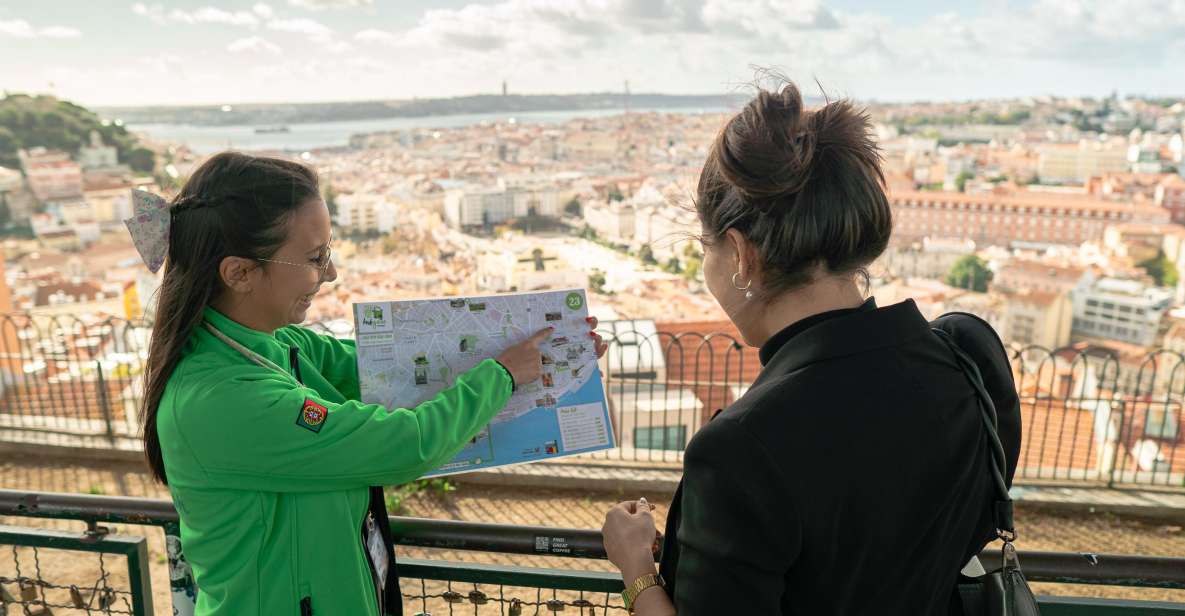
Now for the payoff: the miradouros. The tour includes quick photo-and-walk moments at Portas do Sol Terrace and Miradouro de Santa Luzia (about 5 minutes each for the photos and sightseeing).
These aren’t deep museum-style stops. They’re quick, high-impact breaks where you can actually see Lisbon’s geography: the river, the hills, the tiled rooftops, and the way Alfama and nearby districts stack up over the streets.
If you’re traveling in a season when skies are clear, you’ll feel like you’re collecting a postcard from real life. Even on cloudier days, the angle alone is useful because it helps you understand what you’ll be walking through later.
Convento da Graça, Graça, and Street Art: Lisbon’s Creativity on Display

After those viewpoints, you move into Convento da Graça and the Graça Historic District. You’ll get guided time here, plus sightseeing around the area. Graça is known for its street art feel, and this is the sort of stop that makes Lisbon feel current while still tied to older stone and hill neighborhoods.
I like this part because it’s not only “look at old stuff.” It gives you a sense of what Lisbon looks like now: murals and graffiti where people actually live, not just where someone staged a photo.
Miradouro da Senhora do Monte: The Longer View Stop
Then you reach Miradouro da Senhora do Monte, with about a 10-minute photo and sightseeing window. Compared to the earlier miradouros, this extra time helps. You can slow down, find a good angle, and let the view sink in instead of rushing through it.
This viewpoint is especially helpful if you’re new to the city. You’ll start to understand where the hills begin, how Alfama sits below, and why people always talk about Lisbon’s viewpoints. From this angle, you can connect the dots across multiple neighborhoods.
São Vicente de Fora Monastery: Cloisters and Panoramic Outlook
Next is São Vicente de Fora Monastery, a major historic stop. You’re guided through it, and you get sightseeing time that includes architecture and the surrounding city views.
Monasteries work well in a tour like this because they’re both structured and scenic. You’re not just looking outward—you’re seeing how the building is set up to frame life, reflection, and distance.
Campo de Santa Clara and National Pantheon: Big Monuments on a Tight Schedule
You’ll also pass through Campo de Santa Clara for guided sightseeing, then see the National Pantheon of Santa Engracia. The pantheon is known for its impressive presence, especially its dome. It’s the kind of stop where even a short visit gives you that Lisbon feeling: sacred spaces plus monumental art and identity.
In 90 minutes, you’re not going to do deep, slow touring. But you can still get the visual markers that tell you what kind of city Lisbon is.
Fado Museum and Alfama: Culture Stops That Make Sense Here
The tour includes the Fado Museum and the Alfama district with guided sightseeing. This is one of the better pairings you can make on a short tour because fado isn’t just “a music topic.” It’s tied to place. Alfama’s steep streets, old buildings, and neighborhood life are part of why the music feels like it does.
Even if you don’t go super long inside any one place, this segment helps you place fado in the right context. You’re shown where it belongs in the city’s story, instead of treating it like a stand-alone souvenir.
Commerce Square (Praça do Comércio) and Tagus Views: Lisbon’s Waterfront Moment
Then you arrive at Praça do Comércio, Lisbon’s grand waterfront square. This stop is a natural reset. After hills and viewpoints, the waterfront opens things up: you can look toward the Tagus and see Lisbon’s geography with more space around it.
It’s flanked by impressive buildings, so you don’t just get a view—you get an architectural “stage” for the river. Ending up here in the middle of the loop is a smart rhythm change. It keeps the tour feeling varied rather than repetitive.
Rua da Madalena and Mouraria: The Streets Between the Icons
Between the big sights, the tour also goes through Rua da Madalena and into Mouraria. Rua da Madalena is known for traditional shops, cafes, and historic buildings. Mouraria brings a different vibe: a multicultural feel, narrow lanes, and street life that gives Lisbon a lived-in character.
I like that these street sections are built into the experience. They help you understand Lisbon as a city you’d actually walk through—rather than only standing at the most famous monuments.
Elevador de Santa Justa: A Quick Glimpse That Still Counts
You’ll catch a look at Elevador de Santa Justa (the wrought-iron elevator). The tour is not positioned as a full ride-and-stay ticket, but the glimpse is still useful. It’s one of those structures that helps you understand Lisbon’s vertical life: stairs, elevators, viewpoints, and the city’s persistent climb.
If you later decide you want to ride it, the tour gives you a head start on what you’re looking for.
What’s Included (and Why It Matters)
You’ll get several practical perks that make this tour feel smoother than many “sightseeing only” options:
- Hotel pickup and drop-off
- A speaker so you hear the guide clearly
- Transparent waterproof covers for rainy days, plus blankets for cold weather
- Ginjinha (local drink) included
- Driver and storyteller, plus company liability and personal insurance
The ginjinha detail is more than a cute add-on. It’s a real Lisbon item, and it’s included here so you don’t have to budget time or money to hunt for it later.
The Guide Experience: Friendly, Clear, and Focused on Lisbon’s Story
A standout theme is the guide quality. One review highlighted that the guide Filipe was friendly and available, and that he explained the history of the main monuments well. Another praised an attentive guide who was committed to helping people discover Lisbon.
That matters because Lisbon is a “details city.” A good guide turns a pile of buildings into a readable pattern: restoration of independence, Lisbon’s royal/civic centers, old religious landmarks, and the viewpoints that explain why people built neighborhoods where they did.
Who This Tour Suits Best
This tour is a good fit if you want:
- Major highlights in a short window (1.5 hours)
- A mix of neighborhoods and viewpoints without walking the whole time
- A story-led experience with a guide and clear audio
- Weather flexibility thanks to covers and blankets
It’s less ideal if you need wheelchair/walker access, are traveling with a child under 7, or if you’re pregnant (not suitable per tour info).
Price and Value: Is $56 per Person Fair?
At $56 per person for about 90 minutes, you’re paying for more than transport. You’re also paying for: hotel pickup and drop-off, a private-group tuk-tuk experience, guided storytelling, clear audio, weather-protection gear, and included ginjinha.
If you were doing this on your own, you’d still spend money on multiple rides (or taxis) plus entrance fees and time juggling schedules. Here, the cost bundles the logistics into one smooth package. The tradeoff is that it’s not built for long museum time or monument entry tickets, so you won’t get every interior experience unless you plan a follow-up.
Should You Book Tuk Tuk Lisbon Highlights 1.5-Hour?
Book it if you want a smart, efficient first taste of Lisbon—especially if hills, long walks, or weather are your worry. The mix of Restauradores to Rossio, multiple miradouros, cathedral and monastery stops, and the culture-thread of Alfama and fado make it a strong “orientation + highlights” combo.
Skip it (or plan carefully) if you need accessibility support, if your group includes someone under the minimum age, or if you’re hoping for long, in-depth time inside monuments. For a quick, scenic, guide-led overview, though, this one is a very solid choice.
FAQ
How long is the Tuk Tuk Lisbon Iconic Highlights tour?
It lasts 1.5 hours.
What does the tour cost?
The price listed is $56 per person.
Where is the tour located?
It takes place in Lisbon, Portugal.
Do I get hotel pickup and drop-off?
Yes. Hotel pickup and drop-off are included.
Is this tour private?
Yes, it’s listed as a private group.
What languages are available for the live guide?
The live guide is available in English, French, Italian, Spanish, and Portuguese.
What’s included in the price?
Included are hotel pickup/drop-off, a speaker, blankets for cold days, transparent waterproof covers for rain, a driver and storyteller, company liability and personal insurance, and taste ginjinha.
Is monument entry included?
No. Monument entry tickets are not included.
Is the tuk-tuk wheelchair or walker accessible?
No. The tuk-tuk is not wheelchair/walker accessible.
What should I bring?
Bring a passport or ID card.