
REVIEW · LISBON
Audio Guide City Walk Lisbon for Cruise Guests
Book on GetYourGuide →Operated by OYO Travel GmbH · Bookable on GetYourGuide
Lisbon is best at walking speed. This self-guided GPS audio walk strings together the old-town highlights from your cruise terminal, with English or German tracks timed to where you are. I especially like the built-in pacing freedom: you can stop for photos, duck into a café, and keep moving when you’re ready. One thing to plan for is Lisbon’s steep moments—this route has climbs, so wear grippy shoes.
My other favorite part is how smoothly it feels once you get going. You can play audio manually or use GPS autoplay, so you’re not stuck listening to someone else’s schedule. Expect a relaxed stroll through viewpoints, tile-covered streets, and landmark churches—without a group drifting ahead of you.
In This Review
- Key things you’ll notice on this Lisbon audio walk
- Why this Lisbon walk fits cruise days so well
- Getting set up: the GPS audio guide is the real deal
- From the cruise terminal to Igreja de Santa Engrácia: the walk’s big opener
- Portas do Sol viewpoint: where Lisbon finally shows you the whole picture
- Castelo de São Jorge and the Roman theatre ruins on the way to Sé Patriacal
- Downhill into Baixa: azulejos, Rua Augusta, and Santa Justa’s elevator moment
- Praça do Comércio and the earthquake-era heart of Lisbon
- The return route: more landmarks plus a Fado museum stop
- Price, timing, and value: is $11 worth it?
- What to wear and bring (so the day feels easy)
- Who should do this audio walk, and who should skip it
- Should you book this Lisbon audio city walk?
- FAQ
- How long is the Lisbon audio walk?
- Where does the self-guided tour start and end?
- What languages are included?
- Do I need data or internet during the walk?
- Can I control the audio manually or automatically?
- Is the price per person or per phone?
- How do I get the app and voucher after booking?
- Can I use the voucher for a different date later?
- Are entrance tickets included for sights like elevators or museums?
- What should I bring with me?
Key things you’ll notice on this Lisbon audio walk

- GPS-guided audio that you can run manually or with autoplay
- Cruise-terminal start and finish, so you’re not trying to solve local transit right away
- Big viewpoints in the middle of the walk, especially over the old town toward the Tejo
- Azulejos and Baixa streets, where you’ll see Lisbon’s famous Portuguese tilework up close
- Historic stops back-to-back, including Santa Justa and Praça do Comércio
- Stops you can linger at, since the route is designed for your pace rather than a tour deadline
Why this Lisbon walk fits cruise days so well
If your ship is only in port for a limited window, Lisbon can feel like a blur. This audio experience is built around the reality that cruise guests want results fast: it starts and ends right at the cruise terminal. That means you spend your energy on the city, not on figuring out where to meet or how to get back before the ship’s all-aboard call.
You also get control of the tempo. Instead of watching other people rush to the next photo spot, you set your own rhythm. If you want a slow look at a façade, a quick snack, or a slightly longer stop near a viewpoint, you can do it without worrying that someone with a megaphone is counting your minutes.
Price-wise, it’s refreshing too. At $11 per smartphone, you’re not paying per person for a rigid package. If you’re traveling as a small group and everyone shares one device, you can often stretch the value further than traditional per-person excursions.
You can also read our reviews of more walking tours in Lisbon



Getting set up: the GPS audio guide is the real deal

This is a self-guided walk using an app (the download info comes by email). After booking, you receive an email with a link to get the Aoyo Audioguides app and a voucher code to activate the guide. It can take up to 5 minutes to arrive, so don’t wait until you’re halfway across the terminal crowd.
Here’s how the audio control works in practice:
- You can select audio files via the map or the list
- Or you can use autoplay with GPS, so the next track can start as you walk
You’ll want a charged smartphone. Also, since the voucher code is valid for one smartphone, plan accordingly if you and your travel partner are each hoping to use your own device. Once redeemed, the voucher is non-refundable, so double-check you’re ready to commit to that one phone.
I like GPS-guided audio because it removes the mental load. Lisbon is full of turns, hills, and little squares that look similar. The guide helps you keep your bearings without demanding your full attention like a live narration might.
From the cruise terminal to Igreja de Santa Engrácia: the walk’s big opener
The route begins at the cruise terminal and leads you uphill to Igreja de Santa Engrácia, the National Pantheon of Portugal. This is a strong first stop because it signals the city’s scale and identity right away. You’re not just strolling past random buildings; you’re walking into Lisbon’s story.
What I’d watch for here is the change in atmosphere as you climb. Early on, Lisbon feels like a city of layers—streets tightening, views opening in slices, and architecture changing shape as the terrain rises. Even if you’re not a church-spot person, it’s worth pausing here to reset your eyes.
Then you move on past Igreja São Vicente de Fora, a monastery area that adds context for Lisbon’s religious and historical timeline. It’s a nice transition: one major landmark to another, with enough in-between detail that you don’t feel like you’re sprinting between must-sees.
Portas do Sol viewpoint: where Lisbon finally shows you the whole picture
Next up is Portas do Sol, a viewpoint with an excellent look over the old town toward the Tejo (Tagus River). This is the moment where the hills pay off. The route is a series of “arrive, pause, look” points, and Portas do Sol is one of the best.
If you only give Lisbon a quick glance, your view can feel like postcards. But with an audio track guiding you, the scene turns into something more. You’ll better understand where you are in relation to districts, streets, and the river.
Practical tip: bring your camera up and keep it ready here. The views are wide and the light can change quickly. If you want to capture that classic Lisbon-on-hills vibe, this is where the payoff is.
Castelo de São Jorge and the Roman theatre ruins on the way to Sé Patriacal
After Portas do Sol, you continue up toward Castelo de São Jorge. Even if you don’t plan to spend long inside, the walk toward the fortress is part of the experience. You can feel how Lisbon built its defensive identity on top of geography.
On your way you’ll also see the ruins of an ancient Roman theatre, along the route toward Sé Patriacal (Lisbon’s cathedral). This is a smart pairing because it adds depth to what you might otherwise treat as only medieval scenery. You’re literally seeing evidence of much earlier layers in the city.
Then comes Sé Patriacal. It gives the walk a grounded finish before you start heading down into the lower neighborhoods. If you like architecture, it’s a useful counterpoint to the viewpoints: high lookouts and fortress energy at one end, then monumental church presence as you shift gears.
One consideration: this stretch involves walking on uneven ground and up/down gradients. If your legs already feel tired from getting off a ship early, pace yourself. The advantage of self-guided audio is that you can slow down without feeling like you’re ruining anyone else’s schedule.
You can also read our reviews of more boat tours in Lisbon






Downhill into Baixa: azulejos, Rua Augusta, and Santa Justa’s elevator moment
Once the walk heads down toward Baixa, the vibe changes. Baixa is where Lisbon looks polished and patterned, and you’ll see azulejos—the famous Portuguese tilework—covering many façades. It’s the kind of detail that’s easy to miss when you’re just trying to reach the next attraction, but it becomes a highlight when the audio cue helps you focus.
A key landmark in this section is the Elevador de Santa Justa (the historical elevator). Even if you don’t buy a ticket for the elevator itself (entrance fees aren’t included), it’s one of Lisbon’s recognizable “wow” objects. The area around it also helps explain how Lisbon manages vertical space—how the city connects its hills to its flatter commercial core.
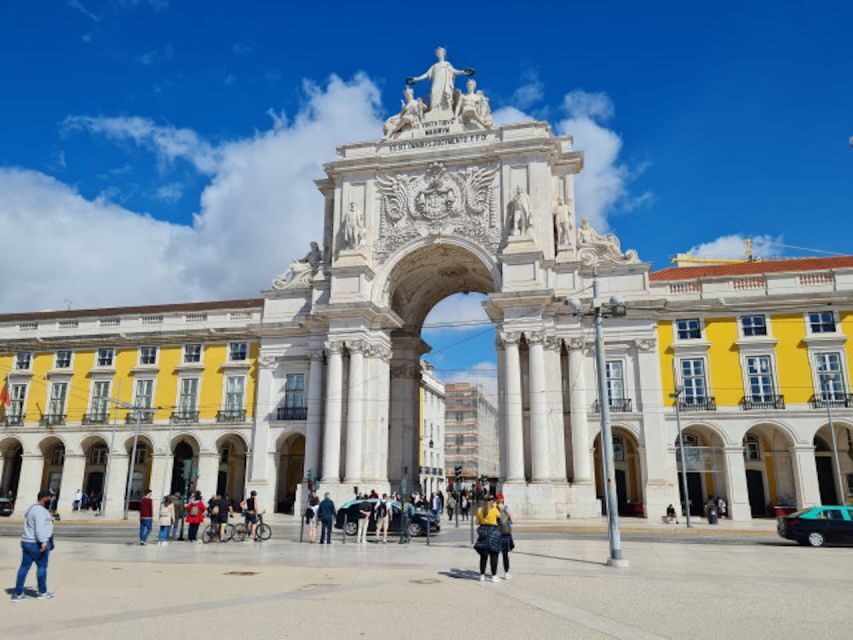
Then you walk along Rua Augusta, passing through the triumphal arch and continuing toward the heart of downtown. This is where you start seeing Lisbon as a city of ceremonies and public space, not just hilltop views.
Praça do Comércio and the earthquake-era heart of Lisbon
The walk reaches Praça do Comércio, one of the central squares in Lisbon. What makes this stop especially meaningful is what the guide helps you connect: before the 1755 earthquake destroyed much of the city, a palace of the king of Portugal stood here.
That kind of context changes how you experience an open square. It stops being only a place to take photos and becomes a way to understand Lisbon’s resilience and reconstruction. Even if you’re not a history person, you’ll likely find yourself looking at the space differently once you know what used to be there.
Also, Praça do Comércio is a great “reset zone.” If you’ve climbed and viewed and listened for a while, this wide, open spot gives you breathing room. You can take a slower loop around the square, grab something to drink, and let your legs catch up before you turn back toward the ship.
The return route: more landmarks plus a Fado museum stop
On the way back to the cruise terminal, the route keeps feeding you landmarks rather than dumping you back into a random street grid. You’ll see more historical buildings and you’ll pass the Fado museum.
Fado is one of Lisbon’s signature cultural threads, and even a quick stop-by can give you a sense of place. The audio guide helps you link what you see to the city’s mood—music tied to neighborhoods, evenings, and identity.
This return section is also where you’ll appreciate the flexibility most. Because the walk is designed for your pace, you can linger where you care and speed up where you don’t. If you want a final look at storefronts in Baixa or a last quick photo before heading back, this is your chance.
Price, timing, and value: is $11 worth it?
At $11 per person (with the important clarification that the guide is per smartphone, not per person), the value depends on how you travel.
If you’re walking solo with one smartphone, it’s a straightforward cost for a self-guided experience that covers multiple major stops, including Santa Engrácia, Portas do Sol, Castelo de São Jorge area, Baixa with azulejos, Rua Augusta, Praça do Comércio, and a Fado museum pass. That’s a lot of sight coverage for a tour that doesn’t charge you for transportation or entrance fees.
If you’re a pair or a small group and can share one phone, the economics get even better. You each get the cultural context and orientation cues while only one device does the work.
In terms of timing, the tour is described as a 2 to 3 hour walk through Lisbon’s old town. That’s a sweet spot for cruise days: long enough to feel like you did something real, not so long that you’re racing your ship or turning your feet into sandpaper.
What to wear and bring (so the day feels easy)
You already know Lisbon has hills. The review-style takeaway here is simple: come ready to climb. One of the most honest things to plan for is that this route includes pittige klimmetjes—steep, noticeable climbs.
Wear shoes with grip. Bring water if you tend to get dry quickly. And keep your phone charged; the experience depends on your device running the audio app.
Also, it’s a walking tour with no transportation included. So you’ll want to build in time to get from ship to terminal start and back again without rushing.
Who should do this audio walk, and who should skip it
This is ideal if you like to:
- Explore at your own pace
- Use audio as a guide to help you connect sights to story
- Stop for photos and a café break without pressure from a group
It’s also a good fit for cruise passengers who want a dependable route that starts and ends at the terminal, with GPS helping you not lose the thread.
If you have mobility limitations, take the “walking + climbs” aspect seriously. The activity is listed as wheelchair accessible, but it’s also marked as not suitable for people with mobility impairments. If walking hills and uneven surfaces could be an issue for you, I’d think twice and compare with a different format (like a seated vehicle tour).
Should you book this Lisbon audio city walk?
Yes, if you want a low-stress way to hit Lisbon’s signature old-town sights in a way that fits cruise timing. The big win is control: GPS audio that lets you move, pause, and return on your schedule.
Book it especially if you’ve been to Lisbon before and think you already know the city. The format helps you notice new angles and street-level details without requiring a live guide to keep up.
Skip it (or switch plans) if you know you can’t handle steep climbs or long walking segments. For everyone else, this is a solid value way to connect Santa Engrácia, Portas do Sol, Castelo area views, Baixa azulejos, Rua Augusta, and Praça do Comércio into one coherent Lisbon experience.
FAQ
How long is the Lisbon audio walk?
The tour runs for about 2 to 3 hours through the most interesting parts of Lisbon’s old town.
Where does the self-guided tour start and end?
It starts and ends directly at the cruise terminal, so you don’t need separate meeting points.
What languages are included?
The audio guide is available in English and German.
Do I need data or internet during the walk?
The guide uses GPS to work with your location, and you download/activate it through the app. The activity info specifically says to use the GPS feature for the audio.
Can I control the audio manually or automatically?
Yes. You can play individual audios or set it to autoplay with GPS. You can also select files via the map or the list.
Is the price per person or per phone?
It’s per smartphone. The voucher code is valid for one smartphone, not per person.
How do I get the app and voucher after booking?
After booking, you get an email with a link to download the Aoyo Audioguides app and a voucher code. It may take up to 5 minutes.
Can I use the voucher for a different date later?
The guide is valid for 365 days, and it’s also described as valid forever after purchase once activated.
Are entrance tickets included for sights like elevators or museums?
No. Entrance fees are not included.
What should I bring with me?
A charged smartphone is the key item, since you’ll rely on the app during the walk.